We specialise in diagnosing skin lesions
Since 2019 we have concentrated on a single field. We examine skin lesions, document them, remove them and provide histopathology — and, where needed, an oncology consultation.
From assessing the lesion to choosing the right method and carrying out the procedure — all in one place.
We specialise in the diagnosis and treatment of skin lesions. Before the procedure the doctor assesses the lesion and decides whether laser removal is right for it — or whether surgery is the better choice.
Others offer laser removal of skin lesions as one of their many services.
We specialise in this.

We bring together skin lesion diagnostics, laser therapy and surgery, so before every procedure the doctor assesses the lesion and chooses the safest way to remove it. Lesions that look benign can be removed with a laser; those that raise doubts are removed surgically, with histopathology.
We bring together skin lesion diagnostics, laser therapy and surgery, so before every procedure the doctor assesses the lesion and chooses the safest way to remove it.
Since 2019 we have concentrated on a single field. We examine skin lesions, document them, remove them and provide histopathology — and, where needed, an oncology consultation.
We created our skin lesion diagnostics programme ourselves and obtained accreditation for it from the Supreme Medical Council of Poland. Only doctors practising at Twoje Znamiona take part in it, which is how we work to one diagnostic standard.
We built our own software, which links your examination result, your medical records and the next stages of care. The system runs only in our centres, so this continuity of care is available to Twoje Znamiona patients alone.
During the examination, the doctor's assessment is supported by a certified AI system. If a lesion raises doubt, the doctor sends its image for a structured second opinion within our nationwide team.
If the doctor recommends an earlier follow-up, a visit within 6 months costs markedly less. Price should not be the reason to put off an examination you have been advised to have.
We are building a nationwide network specialising in skin lesion diagnostics and steadily adding new centres. The examination standard, the doctors' training and the way we work are set across the whole organisation — not one practice at a time.
Competent, well-qualified staff. The only place in Poznań where you can book a videodermatoscopic examination without any trouble. The lady who answered the phone was lovely and explained everything to me. Thank you.
I have been here twice now. Both times it was highly professional. One price for the mole examination even though I have a huge number of moles and it took an hour! The doctor froze off some of the lesions for me. Recommended.
I have never met a doctor so interested in the patient. During the consultation she calmly went through my test results, looked at my mole and only then examined it. The mole qualified for removal, so I had it done.
We ask every patient for a detailed review after their visit.
You choose the service and the time yourself — no waiting for a phone call.
The entrance to the centre is in the building between the Biedronka supermarket and the hairdresser's. Paid parking on site.
They work to our single diagnostic standard — the one we set out in our own training programme, accredited by the Supreme Medical Council and available only to doctors practising at Twoje Znamiona.
The doctor decides during the pre-procedure assessment. They examine the lesion and choose the appropriate removal method. Only lesions that look benign are removed with a laser. We provide skin lesion assessment, laser therapy and surgery, so if surgical excision is the better option, it can be carried out at the same centre.
We use the laser for benign lesions — among others seborrhoeic keratoses, skin tags, viral warts (verrucas) and xanthelasma. Whether a particular lesion is suitable for laser removal is decided by the doctor after examining it — including when it looks similar from the outside to those listed.
No. The laser vaporises the tissue of the lesion, so after the procedure there is no material for histopathology — and only histopathology can confirm what the lesion was. Lesions that raise cancer concerns are not suitable for laser removal; in those cases we recommend surgical excision with histopathology.
The procedure is carried out by a doctor. Doctors working at our centres are trained under our own programme in skin lesion diagnostics, accredited by the Polish Supreme Medical Council. Since 2019 we have worked exclusively with skin lesions — diagnosing them, removing them and providing follow-up care.
For the procedure itself, medical qualification is enough — the doctor assesses the lesion you want removed and decides whether it is suitable for the laser. Assessing every mole on your skin is a separate service: videodermatoscopy. It is worth considering if you do not have your moles checked regularly — you will find both items in the price list above.
Usually 10–20 minutes, depending on the type and number of lesions. The procedure does not require a hospital stay — you go home afterwards. There is no incision and no stitches, so there is nothing to come back to have removed.
We most often carry out the procedure under local anaesthetic. Without anaesthetic, patients usually describe warmth, mild burning or tingling. Sensitivity varies from person to person, so the doctor matches the form of anaesthesia to the type and location of the lesion.
For several weeks before the procedure, avoid tanning and self-tanning products — a tan changes how the skin reacts to the laser. On the day, come with no make-up or cosmetics on the area around the lesion. Tell the doctor about any chronic conditions, medication you take and complications after earlier procedures, and bring any medical records you have.
The price depends on the size of the lesion and where it is — lesions up to 0.5 cm on the trunk and limbs are charged differently from larger ones and from those in sensitive locations such as the face, neck or hands. All the rates are in the price list higher up this page.
Yes. The first lesion is charged at the standard rate, and every further lesion removed during the same visit at the lower rate for an additional lesion. Prices depend on the size and location of the lesion; all the items are in the price list above. The doctor decides how many lesions can be removed in one visit.
A verruca is charged as a lesion requiring more extensive work, and every further one removed during the same visit costs less — you will find the current rates in the price list above. Verrucas are caused by HPV, so a lesion can come back in the same spot or appear next to it; another procedure is then sometimes needed.
You can see the slots available over the coming days straight away in the booking calendar, with no phone call and no waiting to be called back. Phone bookings are open around the clock, seven days a week. Your medical records are available to doctors at all our centres, so your next visit can be in a different city.
A small, superficial wound is left where the lesion was, and a dry scab forms over it. It falls off on its own, usually within a few days to two weeks — how long depends on the size and location of the lesion. Do not pick the scab or soak it for long; the doctor gives you individual aftercare instructions.
The procedure needs no incision and no stitches, so no linear scar from a cut is left. For a while the treated area may stay red or discoloured, and this fades gradually. The final result depends on the type and location of the lesion and on how your skin heals — the doctor talks this through before the procedure.
In most cases one procedure is enough, but recurrence is possible and depends on the type of lesion and on individual predisposition. This applies particularly to viral warts, because the virus can remain in the skin. When a lesion grows back, a laser touch-up is safer than going deeper straight away — a deeper procedure increases the risk of scarring.
For the first few days avoid strenuous exercise, saunas, swimming pools and soaking the treated area. Skin is more sensitive to the sun after laser treatment — for about 4–6 weeks protect it from exposure and use a high-factor sunscreen to reduce the risk of discolouration. If the treated area worries you — for example the pain or redness increases, or discharge appears — contact us without waiting for the scheduled follow-up.
Five features worth checking yourself. None of them settles anything on its own — whether a lesion needs removing is decided by the doctor, based on the videodermatoscopic image.
Imagine two perpendicular lines through the centre of the mole and compare the opposite halves. Do they match in shape, colour and structure?
Most ordinary moles are symmetrical in structure. Asymmetry can be a feature of dysplastic naevi or of melanoma in its early stages. Any asymmetrical mole should be checked in a dermatoscopic examination.
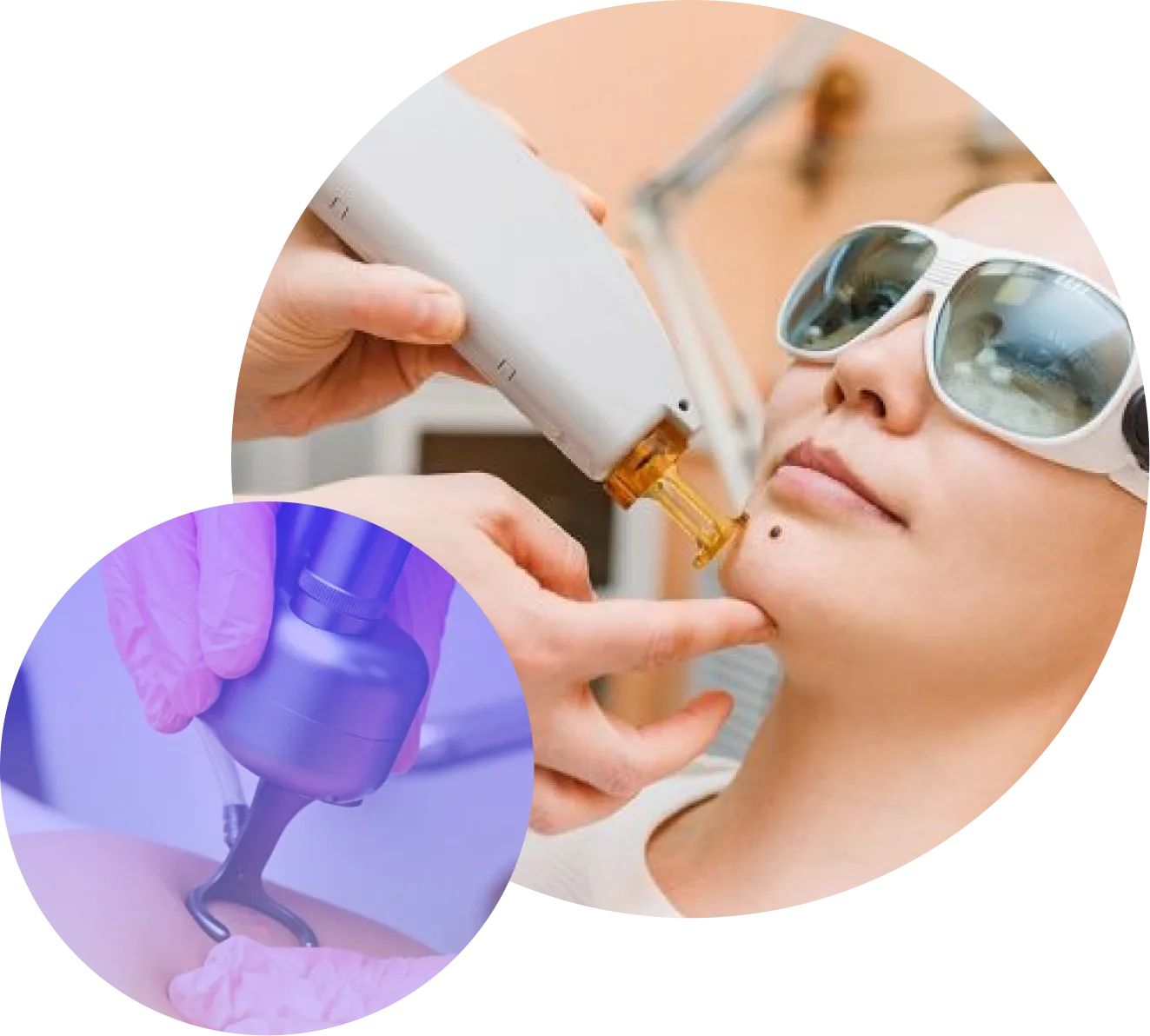
A CO₂ laser removes the tissue of the lesion point by point, with no scalpel and no stitches. The procedure usually takes 10–20 minutes and is most often carried out under local anaesthetic.
Only lesions that look benign are qualified for laser removal — among others selected seborrhoeic keratoses, skin tags, viral warts and xanthelasma. The laser vaporises the tissue, so no material is left for histopathology; lesions that raise cancer concerns are removed surgically, with histopathology.
Videodermatoscopy — computer-assisted mole examination — is currently the best method of preventive screening for dangerous skin cancers. Examining moles with a videodermatoscope is above all about assessing how the moles under observation change, by comparing images taken over time.
The signs of melanoma can be invisible to the naked eye, which is why viewing moles under magnification matters. A specialised camera placed against the skin sends images to a computer screen and provides up to 140× magnification, revealing structures within the mole. An experienced doctor carries out the examination, supported by a certified AI system that provides an additional check without replacing the doctor's judgement.
Before deciding whether a mole should be removed surgically or can safely be treated with a laser, it must be examined with a dermatoscope.
The doctor uses the examination findings to choose the appropriate method. Atypical moles need to be removed surgically, while non-invasive methods are reserved for benign lesions. Laser treatment, cryotherapy and electrocoagulation do not leave a sample for histopathology, which is the only way to make a definitive diagnosis.
After a melanoma diagnosis, the patient may need further procedures, including a wider excision around the original site and a sentinel lymph node biopsy. An oncology consultation is essential at this stage.
During the consultation, the oncologist explains what should happen after a cancerous lesion has been removed, including the necessary follow-up examinations, possible adjuvant treatment and treatment options for advanced melanoma.
Does your skin need diagnosis or treatment? At Twoje Znamiona you can book a dermatology consultation with a doctor who works not only on assessing moles, but also on treating conditions of the skin, hair and nails.
We help patients with problems such as acne, atopic dermatitis, psoriasis, fungal infections, eczema, inflammatory lesions, itching, seborrhoea, nail problems and recurring rashes. During the visit the doctor will assess your symptoms, carry out the diagnostic work and propose what to do next or how to treat it. If what you want is a preventive assessment of all your moles for melanoma, choose the videodermatoscopic examination instead.